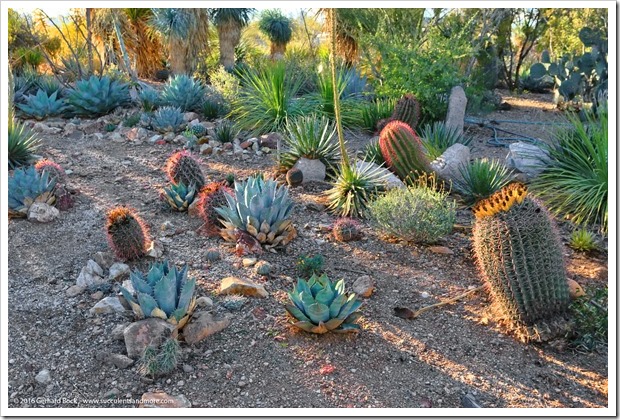
FALL GARDEN SALES IN THE TUCSON AREA
News and Events for the Tucson Gardener.
On this website you will find links to most of the Gardening Clubs in Tucson,
as well as a calendar of events for major gardening events, such as plant sales, garden tours, etc.


Photos of Plants featured at a recent weird plant sale at the Tucson Botanical Gardens
* * * * * * * * * * * * * * * * * * * * * * * * * * * * * *
Choices for Sowing Seeds
9:43 pm November 11th, 2009The cool-season vegetable garden starts with new plants or seeds. If you are an early operator there may not be the right plants for you in the nurseries so you have to sow seeds. Because there’s usually a wide range of varieties in seeds packets that are available it’s often the way to go..
Now, in late October or early November, you are presented with a choice between sowing seeds indoors or out in the garden. My own preference is to sow seeds in the garden because the soil is warm after a hot summer, and if it is not, you can warm it by covering the sown seeds with clear plastic. A plastic cover also preserves soil moisture and you don’t need to come to the garden every day to water. Furthermore, there is better light out in the garden while light indoors is seldom adequate. Seeds sown in little containers by the kitchen window usually start their life by leaning towards the light and this weakens them–they seldom make strong plants this way.
You’ll be more successful if you sow seeds at the right depth and the rule of thumb is to put them in the ground at three times their thickness.There is an exception, though, in the case of lettuce which, for some reason, needs to be sown very near the surface. Some people even say that lettuce needs to see the light of day in order to germinate.
But here is a rule that will serve you very well, especially if you start early. Don’t sow all your seed at one time, but make a succession of sowings so you subsequently spread your harvest over time and thus avoid too much of anything by sowing the whole packet at once.
Also, don’t sow your seed in Vee shaped drills because they tend to fall down to the botttom where they sit on top of one another. Instead, avoid resultant crowding and attendant competition by preparing a wide drill that allows seed to rest side by side. Sow lightly.
If you don’t use clear plastic over the seeds you will have to visit the seedbed every day to water, maybe twice a day if the weather is unseasonably warm, windy and dry. When watering try to hold the nozzle up so the water gently comes out and falls like rain. Don’t blast the young seedings as with a fire hose. Birds, such as quail and thrashers, will be tempted to eat up your seeds as soon as they appear. You can protect them by spreading a light sheet (or even better, Floating Row Cover that you buy at a nursery) or by building a little box of small-meshed chicken wire. The floating row cover comes in handy later when we get frosts
There’s a very effective way to raise seedlings, and at the same time get an early harvest of “greens” by scattering seeds quite lighty in a square foot space. As time goes by you thin out those smaller seedlings and eat them. Keep the larger stronger plants as long as you can and eat them when they are mature. In this way you avoid pulling up a young plant and shocking it and you let them send their roots down without trsnaplant shock.
Most of our cool-season vegetables have small seeds, but peas and faba beans have large enough seeds for you to measure the spacing by using a measuring stick. Large plants need more room to avoid crowding. We tend to sow seeds too thickly.
Seed sowing can go on until early March using interval sowing, but the growth will slow down in December and January when both the weather and the soil is cold. A way to sidestep this period of temporay dormancy is to erect a tunnel of clear plastic over a part of your garden using tubing as supporting framework. You’ve made a little greenhouse and you’ll need to open it up if we get days of bright sunshine. But close it up again before the sun goes down to conserve the warmth.
****************************************************************************************************
Backyard Gardening gaining in popularity!
March 8, 2008 article from the Arizona Republic on backyard gardening.
+++++++++++++++++++++++++++++++++++++++++++++++++++
ONGOING TUCSON GARDENING EVENTS
Plant Clinic: Master Gardeners are available to answer your gardening questions over the phone or on a walk-in basis weekdays 8:30 a.m. - 4:30 p.m. at the Pima County Cooperative Extension, 4210 N. Campbell Avenue. Phone 626-5161
Gardening for the Newcomer: This introductory class will familiarize newcomers or new homeowners with Tucson's seasons and soils. Discussion will cover proper techniques for planting and watering and how to create a garden of beauty and comfort in our desert environment. Class concludes with a walking tour of the Tucson Botanical Gardens.
Taught by trained docents. No preregistration required. 9:30 a.m. - noon on the first Thursday and third Saturday of the month at Tucson Botanical Gardens, 2150 N. Alvernon Way. Price $12 (includes admission to the gardens) More info: 326-9686 x39 or http://www.tucsonbotanical.org/
Tucson Gardening Clubs and Organizations:
The Gardeners of Tucson
is a local gardening club that has been around since 1959.
They meet the second Tuesday of the month at 7:30 PM
at 3202 E. First Street (1 block east of Country Club and
one block south of Speedway. They do not have a website.
But further information can be found here
For more information call the President, Jacqueline at 292-0504.
**************************************************
The Tucson African Violet Society
has meetings on the Northwest and Far East side monthly.
Their newsletter is published monthly and
you can find it on their website.

**************************************************
Tucson Area Iris Society
meets monthly (more or less) in various
locations (except summer). In spite of Tucson's very hot summers,
irises actually do very well in Tucson
For information on how to grow irises there is a
culture page on the Tucson Area Iris Society's webpage.

***********************************************
Tucson Cactus and Succulent Society
Nearly 1,000 members belong to the very active Tucson
Cactus & Succulent Society which meets the first Thursday
of every month at 7PM at 2099 E. River Road at the Junior
League of Tucson Kiva Building.
************************************************
Tucson Organic Gardeners
meet at 7:00 PM on the third Thursday of each month
September thru April at St. Marks Presbyterian Church
3809 E. Third Street (near Alvernon/Speedway).
***********************************************
Tucson Rose Society
meets at 6:30 PM on the first Tuesday of the month
at St. Phillips in the Foothills Church on the northeast
corner of N. Campbell and E. River Road
************************************************
The Tucson Watergardeners
meet the 4th Thursday of every month from February to October
at 7:30 PM at the Junior League of Tucson Kiva Building,
2099 East River Road. They are a club for people who enjoy
the many aspects of watergardening; plants, fish or both
************************************************
Tucson Area Gardening Talks, Lectures, Demonstrations:
The local Master Gardeners from the University of Arizona
Pima County Extension offers talks on timely gardening topics weekly.
The talks are every Wednesday at 9:00 AM at the Cooperative
Extension Garden Center, 4210 N. Campbell and at 1:00 PM at
the Wilmot Library, 530 N. Wilmot Rd as well as Fridays at 1:00 PM
on the Northwest at the Oro Valley Public Library,
1305 W. Naranja Drive in the large meeting room.
Talks are held monthly EXCEPT June, July and August
For subjects of these weekly talks visit
http://www.ag.arizona.edu/pima/gardening/talks.html
LOCAL TUCSON AREA GARDENING WEBSITES:
Arizona Native Plant Society
Arizona Sonora Desert Museum
California Rare Fruit Growers-Southern Arizona Chapter
Community Gardens of Tucson
Desert Survivors
Native Seeds/SEARCH
Pima County Master Gardeners Website
Southeast Arizona Butterfly Association
Tohono Chul Park
Tucson Area Iris Society
Tucson Bonsai Society
Tucson Botanical Gardens
Tucson Organic Gardeners
Tucson Rose Society
The following is from the blog at the communitygardensoftucson.org webpage,
written by George Brookbank
Choices for Sowing Seeds
9:43 pm November 11th, 2009The cool-season vegetable garden starts with new plants or seeds. If you are an early operator there may not be the right plants for you in the nurseries so you have to sow seeds. Because there’s usually a wide range of varieties in seeds packets that are available it’s often the way to go..
Now, in late October or early November, you are presented with a choice between sowing seeds indoors or out in the garden. My own preference is to sow seeds in the garden because the soil is warm after a hot summer, and if it is not, you can warm it by covering the sown seeds with clear plastic. A plastic cover also preserves soil moisture and you don’t need to come to the garden every day to water. Furthermore, there is better light out in the garden while light indoors is seldom adequate. Seeds sown in little containers by the kitchen window usually start their life by leaning towards the light and this weakens them–they seldom make strong plants this way.
You’ll be more successful if you sow seeds at the right depth and the rule of thumb is to put them in the ground at three times their thickness.There is an exception, though, in the case of lettuce which, for some reason, needs to be sown very near the surface. Some people even say that lettuce needs to see the light of day in order to germinate.
But here is a rule that will serve you very well, especially if you start early. Don’t sow all your seed at one time, but make a succession of sowings so you subsequently spread your harvest over time and thus avoid too much of anything by sowing the whole packet at once.
Also, don’t sow your seed in Vee shaped drills because they tend to fall down to the botttom where they sit on top of one another. Instead, avoid resultant crowding and attendant competition by preparing a wide drill that allows seed to rest side by side. Sow lightly.
If you don’t use clear plastic over the seeds you will have to visit the seedbed every day to water, maybe twice a day if the weather is unseasonably warm, windy and dry. When watering try to hold the nozzle up so the water gently comes out and falls like rain. Don’t blast the young seedings as with a fire hose. Birds, such as quail and thrashers, will be tempted to eat up your seeds as soon as they appear. You can protect them by spreading a light sheet (or even better, Floating Row Cover that you buy at a nursery) or by building a little box of small-meshed chicken wire. The floating row cover comes in handy later when we get frosts
There’s a very effective way to raise seedlings, and at the same time get an early harvest of “greens” by scattering seeds quite lighty in a square foot space. As time goes by you thin out those smaller seedlings and eat them. Keep the larger stronger plants as long as you can and eat them when they are mature. In this way you avoid pulling up a young plant and shocking it and you let them send their roots down without trsnaplant shock.
Most of our cool-season vegetables have small seeds, but peas and faba beans have large enough seeds for you to measure the spacing by using a measuring stick. Large plants need more room to avoid crowding. We tend to sow seeds too thickly.
Seed sowing can go on until early March using interval sowing, but the growth will slow down in December and January when both the weather and the soil is cold. A way to sidestep this period of temporay dormancy is to erect a tunnel of clear plastic over a part of your garden using tubing as supporting framework. You’ve made a little greenhouse and you’ll need to open it up if we get days of bright sunshine. But close it up again before the sun goes down to conserve the warmth.
Labels: desert, plant sale, plants, Tucson